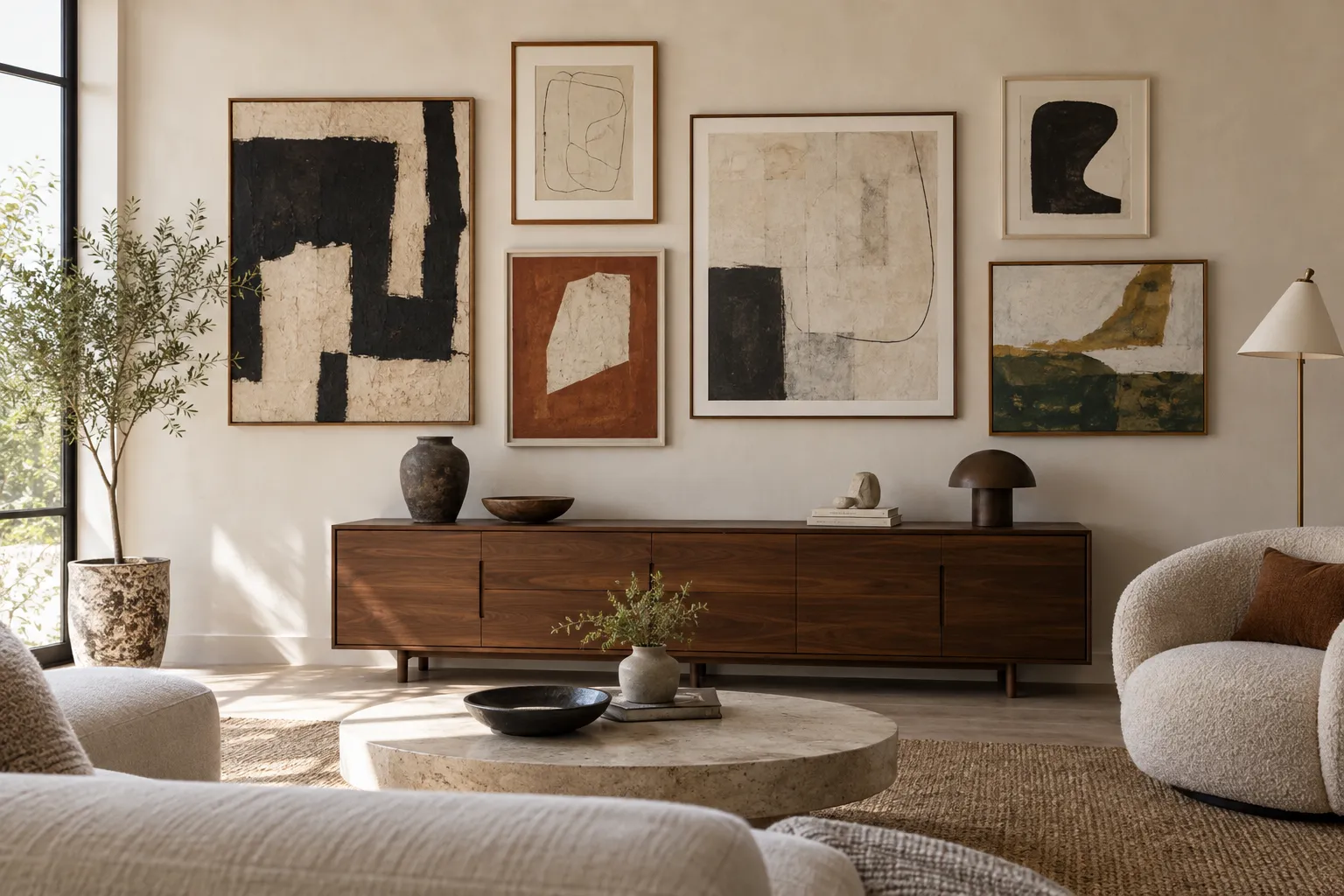
An art wall is most interesting when it reflects attention accumulated over time. It does not have to be a matched set purchased in one afternoon, and it does not need to fill every inch of a wall to feel complete. The arrangement can bring together prints, photographs, drawings, and objects that matter for different reasons. What makes them belong together is the relationship among scale, color, framing, and the space around them. Rushing the process often creates two problems: work is chosen to fill a gap rather than because it is valued, and the hanging plan is fixed before the collection has a chance to develop. A more useful approach begins with what you own and what you enjoy looking at every day. Choose a wall, understand its light and furniture, then let the display grow with a clear but flexible structure.
Start with the work you want to live with
Lay out the pieces you already have and ask which ones still hold your attention. They need not share a subject or medium. A family photograph may sit comfortably beside an abstract print if their scale, tone, or framing creates a conversation. Set aside pieces kept only because they once filled a space. A smaller group of meaningful work can make a stronger wall than a complete arrangement of indifferent images.
Think about where each piece will be seen. A subtle drawing may reward a position near a seat, while a bold work can hold a longer view from a doorway. Some artwork may require protection from direct sun, moisture, or heat; check the medium and framing advice before selecting a location. The ideal wall is not necessarily the largest empty one. It is the place where the work can be enjoyed safely and often.
Avoid forcing a purchase simply because the layout has an open corner. Live with a temporary gap. The missing piece may become an opportunity to find work that connects to a future trip, artist, or memory. A collection with time in it can feel more personal than one that was completed to meet a deadline.
Let the wall and furniture set the boundaries
Measure the wall, but also note the furniture beneath it, doors nearby, switches, and the view from adjacent spaces. A collection above a sofa should relate to the sofa's width and the height of seated viewers. In a hallway, people will see it while moving and often at close range. A wall beside a dining table may be viewed for long periods, so fine detail can be rewarding there.
Mark the area you want the arrangement to occupy rather than treating the whole wall as available. Painter's tape or paper templates can help you see the proposed outer boundary. Leave enough space above furniture for the composition to breathe, and consider whether lamps, plants, or shelves already claim part of the visual field. The wall and its surrounding objects form one scene.
Think about the direction of growth. A collection that may expand later can begin with a strong center and leave room at the edges. Another might follow a clear horizontal line that can continue along a corridor. This planning need not be rigid, but it helps prevent an early piece from being hung in a position that makes every later addition awkward.
Find an organizing principle that is not too strict
An art wall can be tied together by a shared frame color, a consistent spacing rhythm, a limited palette, a repeated subject, or a common alignment. Choose one or two principles rather than all of them. If every frame, size, and gap matches exactly, the arrangement may feel more like a product display than a collection. If nothing relates, the wall can feel restless.
One approach is to choose a larger anchor piece and arrange smaller works around it. Another is to align several top or bottom edges while allowing frame sizes to vary. A loose salon arrangement can be expressive, but it still benefits from an underlying balance of visual weight. Place darker, denser works where they help hold the composition rather than clustering them accidentally at one side.
Color relationships can be subtle. A muted blue in one image may connect to a ceramic object or a line in another print. The frames can do some of that work too. Mixing timber, metal, and painted finishes can look collected if their profiles or tones relate. The organizing principle should help the eye move through the display without making every piece feel identical.
Test the layout on the floor
Before making holes, arrange the framed work on the floor in an area similar to the wall's available dimensions. Take a photograph from above and try several versions. Move pieces until their distances feel intentional and the composition has a center of gravity. This is a low-risk way to discover that a small image needs more breathing room or a heavy frame belongs lower.
Paper templates can then move the arrangement to the wall. Cut or trace the frame outlines, mark the hanging point on each template, and tape them up. Step back to view the wall from the doorway and from the seats where it will be seen most. The floor layout may appear balanced from above but feel too high or too compressed once upright.
Do not expect mathematical perfection. Small differences in spacing can make a wall feel natural, especially when frames vary. What matters is that the gaps appear chosen rather than accidental. If the arrangement feels crowded, remove a piece before reducing every gap. Negative space gives the individual works room to register.
Choose frames that protect and support the work
Framing affects the artwork and the room. A slim dark frame can give a light drawing definition; a wider timber frame may add warmth; a mat can create space around a small image. The choice should respond to the medium and the visual character of the collection. Frames need not match, but their materials and proportions should make sense together at the scale of the wall.
Protection matters. Ask a qualified framer about suitable materials for valuable or delicate work, including mounting and glazing choices. Avoid assuming that any backing or adhesive is harmless over time. For inexpensive prints, simple ready-made frames may be entirely appropriate, but the work should still sit securely and be easy to clean without touching the image.
Consider weight and hanging method before purchase. A large frame may require stronger wall fixings than expected. If the collection includes three-dimensional objects, their mounting needs can differ substantially from paper art. The frame is not just a border; it is part of how the piece is displayed, protected, and maintained.
Hang at a height that supports looking
The correct height is determined by the people and room using the wall, not by one universal rule. In a hallway, work is usually viewed while standing. Above a sofa or dining bench, seated sightlines matter. A tall ceiling does not automatically mean art should be placed high; that can disconnect it from furniture and make details difficult to appreciate.
Step back from the templates and look from all relevant positions. Does the arrangement feel connected to the sofa or table beneath it? Can smaller works be seen comfortably? Are any frames too close to a door swing or vulnerable to a chair being pushed back? Adjust the composition as a group rather than correcting one piece at a time without regard to the whole.
Wall construction determines safe hanging hardware. Different surfaces and frame weights require different fixings, and concealed services may be present. For heavy or valuable work, use qualified local help if needed. A well-planned art wall should be secure as well as visually considered.
Work with daylight and evening light
Light influences what the work looks like and how well it will age. Strong direct sun may be unsuitable for some media, while dim conditions can make subtle images disappear. Observe the wall at several times of day. A window opposite the display may cause reflections in glazing even if it does not shine directly on the work. A simple change in position or glass choice may improve viewing.
After dark, general room lighting may be enough. If a particular piece needs focused illumination, test the angle from the main viewing positions. A bright picture light can produce glare or make neighboring works feel neglected. Gentle, even light may suit a mixed collection better than dramatic spots on every frame. Electrical additions should be reviewed by qualified local professionals and by the art's care requirements.
Remember that a wall is seen when the lights are off too. Frames, mats, and spacing contribute to the room's composition throughout the day. Lighting should reveal work that already belongs there, not compensate for an arrangement chosen without regard to the room.
Let the collection grow within a budget
An art wall does not require a large immediate purchase. Original work, editioned prints, family images, vintage finds, and personal photographs can coexist when chosen with care. The budget should include framing and hanging, which can be significant relative to the price of a small piece. It may be better to frame a few works well than to buy many simply to fill the wall quickly.
Keep records where they matter: artist, title, date, source, and care information. For work acquired from an artist or gallery, retain documentation provided with the purchase. This helps with future reframing, insurance questions, or simply remembering the story of a piece. It also encourages intentional collecting rather than anonymous accumulation.
Allow the display to change. A new work may alter the balance; a photograph may be replaced as family life evolves. If the underlying spacing and anchor are strong, the wall can accept those changes without a complete restart. A collection should remain alive rather than becoming an untouchable finished project.
When deciding whether to add a new piece, imagine where it would live if the current wall did not exist. If you would still want to see it, it may be a meaningful addition. If it appeals only because it matches a vacant rectangle, wait. Look at the work in person when possible, or request clear information about its size, medium, condition, and framing before buying remotely. The color shown on a screen can differ from the object. For a vintage or second-hand piece, allow time to assess condition and any conservation needs. There is no requirement for every work to have equal monetary value or provenance. A personal sketch can hold a wall together as effectively as a more expensive print when its scale and placement are right. The collection becomes richer when each addition has its own reason to be there.
Edit the display once it is on the wall
After hanging, live with the arrangement for a week before declaring it complete. Notice where your eye goes first and whether some work is lost. View it in morning and evening light. A piece that felt essential on the floor may feel redundant on the wall; another may need a little more space. Small adjustments are normal, especially in a loose composition.
Consider the room's other visual voices. If the wall competes with a patterned rug, open shelving, and a bold lamp, removing one frame may give everything more clarity. If the room feels too quiet, a piece with a different scale or material may provide energy. The aim is not to maximize either uniformity or variety but to make the relationship among objects feel deliberate.
Maintain the work according to its needs. Dust frames carefully, check that fixings remain secure, and respond if moisture or strong light affects a piece. An art wall is part of a home, so it should be cared for without becoming a source of anxiety. Its richness comes from the time spent choosing, placing, and living with the work—not from how quickly every gap was filled.
Collect slowly, lay out at full size, and leave breathing room around the composition.
These are general design considerations. Product dimensions, materials, installation requirements, and care instructions should be checked with the relevant maker or professional before purchase or work begins.