A sofa is both a piece of architecture within a living room and a place where people spend unremarkable hours. Its outline may be the first thing you notice, but its real value emerges in the way it supports conversation, reading, rest, and the wear of ordinary life. A good choice balances proportion, seat geometry, upholstery, construction, delivery access, and the household's habits. That is a more demanding brief than finding a shape that looks right in a photograph. The most useful comparison starts at home. Measure the room and the route the sofa must travel to reach it. Sit on a sofa you already know and record what feels comfortable or frustrating. Think about who will use it, how they sit, and what else the room must accommodate. With those observations in hand, product descriptions become more meaningful, and visual preferences can be weighed against practical needs instead of replacing them.
Begin with the room, not the product page
Draw the living room and mark doors, windows, heating or cooling equipment, outlets, and the routes people use most. The sofa should support a clear furniture arrangement without forcing everyone to navigate around it. Tape its proposed footprint on the floor. Then walk past it, open adjacent doors, and imagine people seated while someone else crosses the room. A sofa that fits between two walls can still be too large if it blocks the path to the balcony or leaves no usable place for a table.
Consider the view from each seat and from the entrance. A low back may preserve daylight and long sightlines in an open plan. A higher back can create shelter or help define a conversation area. A deep sectional may be ideal for a household that lounges together, but it can dominate a narrow room and reduce flexibility. Two smaller pieces sometimes allow better circulation and conversation than one very large sofa.
Do not forget the furniture around it. A seat needs a nearby surface for a cup or book, lighting suited to the activity, and enough room to stand. The right sofa is one part of a coherent room, not an isolated object with a favorable measurement.
Measure the delivery route with equal care
An elegant sofa is useless if it cannot reach the living room. Measure the front door, hallway, stairwell, lift, and any tight turn. Account for handrails, light fixtures, and the space needed to rotate a bulky piece. Product dimensions may describe the assembled sofa rather than the packaging or individual components, so ask the seller for delivery dimensions and any information about removable legs or modular sections.
Check the delivery terms before ordering. Who carries the sofa inside? Is assembly included? What happens if access is impossible? Policies vary, and large-item returns can be inconvenient or costly. A modular design may solve a difficult route, but only if the largest module fits through each opening. Confirm how modules connect and whether they can be moved again without damage.
Think ahead to the life of the piece. If a move is likely, a design that can be separated or handled by fewer people may be valuable. This does not mean everyone needs modular furniture. It means the practical journey of the sofa should be evaluated as carefully as its appearance in the final room.
Compare seat depth and posture, not only softness
Comfort is personal and changes with how a sofa is used. A deep seat can be wonderful for curling up, but a shorter person may need a cushion behind the back to sit upright with feet on the floor. A shallower seat may support conversation and reading while feeling less relaxed for lounging. Seat height, back angle, arm height, and cushion shape all contribute. The phrase "comfortable sofa" tells you little until you know the posture it supports.
If possible, sit for more than a few seconds. Try reading, turning toward another person, and getting up without using the arms. Notice whether the back supports you or pushes you forward, and whether the cushion feels stable under different positions. If shopping online, compare the listed dimensions with a sofa you know well. Measure from the front of its seat to the back cushion rather than relying only on the overall depth.
Household members may have different preferences. A sofa that suits one person perfectly may be uncomfortable for another. Consider whether removable cushions, a companion chair, or an ottoman can provide flexibility. Buying the deepest possible model is not automatically generous; it may simply make upright sitting harder.
Understand cushions as a long-term choice
The feel of a cushion depends on its materials, construction, and how it is used. A very soft seat can feel inviting in a showroom yet require frequent reshaping. A firmer one may hold its form better but feel less relaxed. Ask what fills the seat and back cushions, whether covers can be removed, and what care the maker recommends. Vague descriptions such as "premium comfort" are less useful than a clear explanation of construction and maintenance.
Look at how cushions relate to the frame. Do they fit cleanly, and can they be rotated or replaced? Are back cushions likely to slip when someone leans against them? A fixed seat can create a tidy silhouette, while loose cushions make cleaning or refreshing easier in some designs. Neither approach is universally better; the choice depends on how much adjustment the household is willing to do.
Consider the edges that support movement. An arm at a useful height can make sitting and standing easier, while a very wide arm may consume space that could have been seating. A low, sculptural arm may look light but offer little support. The right details often become clear only after you try the sofa in the positions you use at home.
Choose upholstery for your household's real habits
Color is usually the first upholstery decision, but fabric composition, weave, cleaning method, and repair options will shape the longer relationship. A pale sofa can be practical if its cover is washable and the household is comfortable caring for it. A dark sofa can still show lint, dust, or pet hair. Tight weaves, loose textures, leather, and specialty fabrics behave differently, and the right choice depends on use rather than a simple durability label.
Request a swatch whenever possible. View it in the room during daylight and evening, place it beside the floor and rug, and feel it against skin. Online images can hide undertones and scale of weave. Ask the maker how to respond to common spills and whether the care instructions allow the cleaning methods you would realistically use. A fabric described as easy-care may have specific restrictions.
Texture is a design tool as well as a practical consideration. A slightly varied weave may sit comfortably with timber, stone, or a patterned rug. A very delicate surface may look beautiful but feel stressful around pets or frequent visitors. Choose a material you can live with, not one that makes the room feel off-limits.
Look beneath the silhouette
The frame and internal construction influence how a sofa ages, yet these details are often less visible than fabric. Ask about frame materials, joinery, suspension, and warranty terms. A brand that can explain how the piece is built and how parts can be serviced gives you more useful information than one relying entirely on styling language. Compare what is actually specified rather than assuming that price or appearance proves quality.
Look at the legs and base. Can a vacuum reach underneath, or will the gap collect dust while remaining hard to clean? Are the legs removable for delivery? Does the base feel stable when several people sit? If a sofa has moving or reclining parts, understand what maintenance and access those mechanisms require. Extra functions can be worthwhile, but they also add things that may need service.
Repairability matters for a large purchase. Ask whether replacement covers, cushions, or components are available and for how long the maker expects to support them. No sofa stays new forever. A design that can be cleaned, repaired, and adapted may provide better value than one whose surface is difficult to replace after ordinary wear.
Decide between a sofa, sectional, and modular system
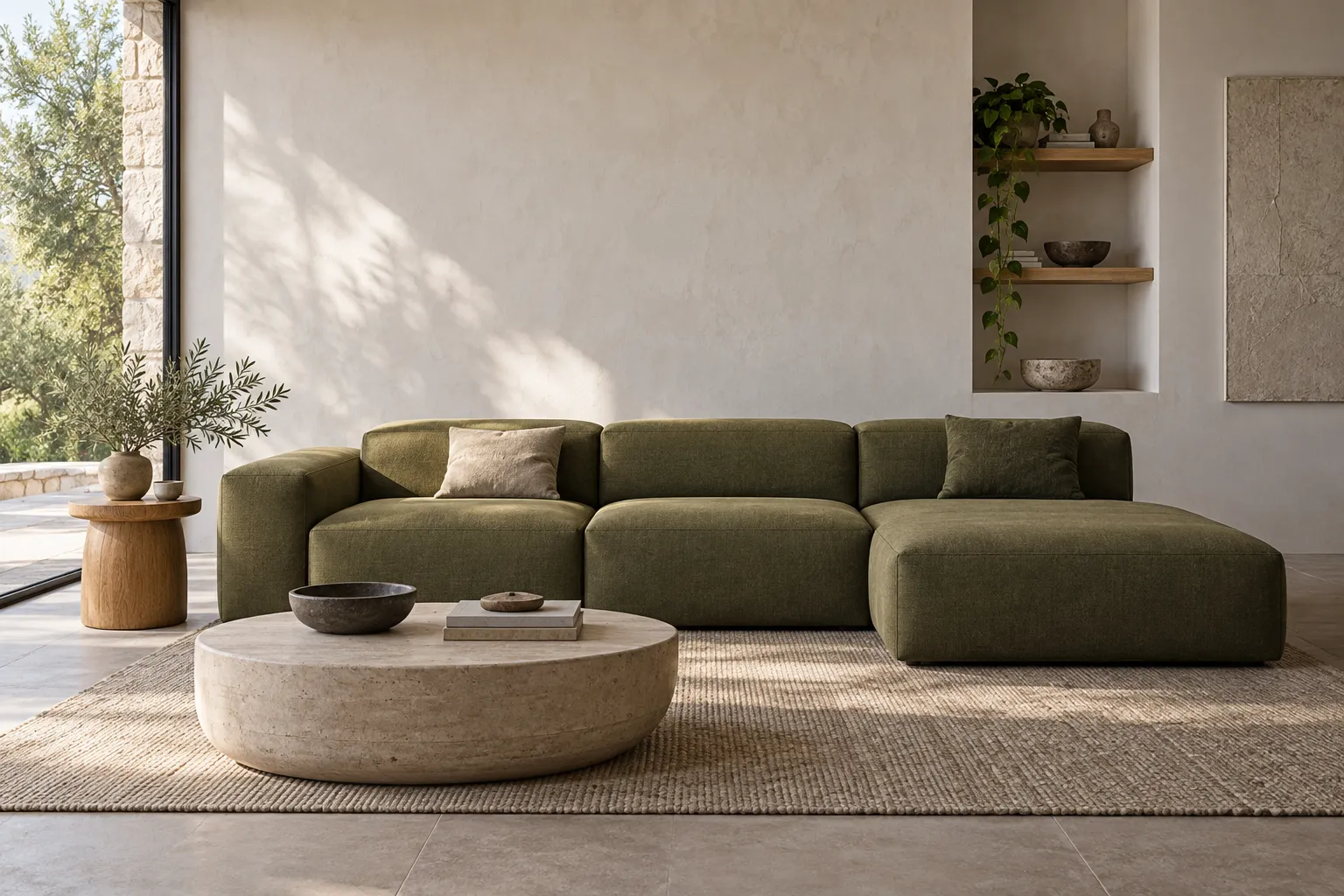
A straight sofa is flexible and can often be paired with chairs as household needs change. A sectional can define a lounge and offer room to stretch out, but its fixed orientation may be awkward if the room is rearranged. Modular pieces can adapt over time and may simplify delivery, yet their connectors, seams, and individual proportions should be examined. Choose the format around the floor plan and behavior, not the category's promise.
Test the arrangement with footprints. A sectional's chaise may block a route that a separate ottoman would leave open. Two sofas facing one another may support conversation better than a long sofa aimed at a screen. A compact sofa and one excellent chair can make a small room feel more versatile than a single oversized piece. In a shared home, consider whether everyone can sit in a posture they enjoy.
Look beyond the ideal arrangement shown in a product photograph. Where will a lamp go? Can a side table be reached from the corner seat? Does the sectional leave one person isolated at the far end? If flexibility is valuable, favor pieces that can be rearranged without requiring a completely new room layout.
Balance proportion with visual character
The sofa's visual weight comes from more than its width. A low, long silhouette may feel calm in a room with generous horizontal lines. Tall arms, thick cushions, or a solid base may appear heavier even at a smaller size. Legs can reveal more floor and make a piece look lighter, though they may not suit every style or cleaning preference. Compare the sofa in relation to windows, tables, and the height of the room.
Color can either anchor or soften the composition. A deep tone may ground a pale room; a neutral can allow art or architecture to lead. Avoid selecting a color solely because it is described as timeless. The most enduring choice is one that works with fixed elements and that you enjoy seeing daily. Test a swatch against those elements, including at night when artificial light changes the effect.
Do not require the sofa to provide every bit of personality. A simple, well-proportioned piece can be given character through a rug, lamp, or chair that may be easier to change later. Conversely, a sculptural sofa can be the right anchor when the rest of the room is quiet. The key is a clear hierarchy rather than competing statement pieces.
Make the purchase decision in a sensible order
Create a short list of non-negotiables before looking at colors: maximum footprint, delivery access, desired seat depth, care requirements, and budget. Compare a few candidates against the same list. This prevents a beautiful image from making practical concerns disappear. If a specification is missing, ask the seller rather than guessing. A clear return policy and usable warranty information should be part of the comparison.
When a showroom visit is possible, take measurements and sit for long enough to notice posture. If buying online, study the dimensions, fabric sample, construction details, and photographs from several angles. Check whether reviews discuss the aspects that matter to you, while recognizing that another household's comfort preference may differ. Avoid treating a single glowing or negative comment as definitive evidence.
Finally, imagine the sofa after several years of normal use. Can you clean around it, refresh a cover, move it if necessary, and still use the room comfortably as routines change? Notice whether the product information makes these questions easy to answer; missing detail is itself useful information when comparing a major purchase. Keep those answers alongside the dimensions when you compare candidates. A sofa worth living with answers those questions as convincingly as it answers the visual one. Its form should make everyday life easier, not ask the household to adapt itself to a photograph.
Check dimensions and access, compare seat geometry, and read care information before choosing color.
These are general design considerations. Product dimensions, materials, installation requirements, and care instructions should be checked with the relevant maker or professional before purchase or work begins.